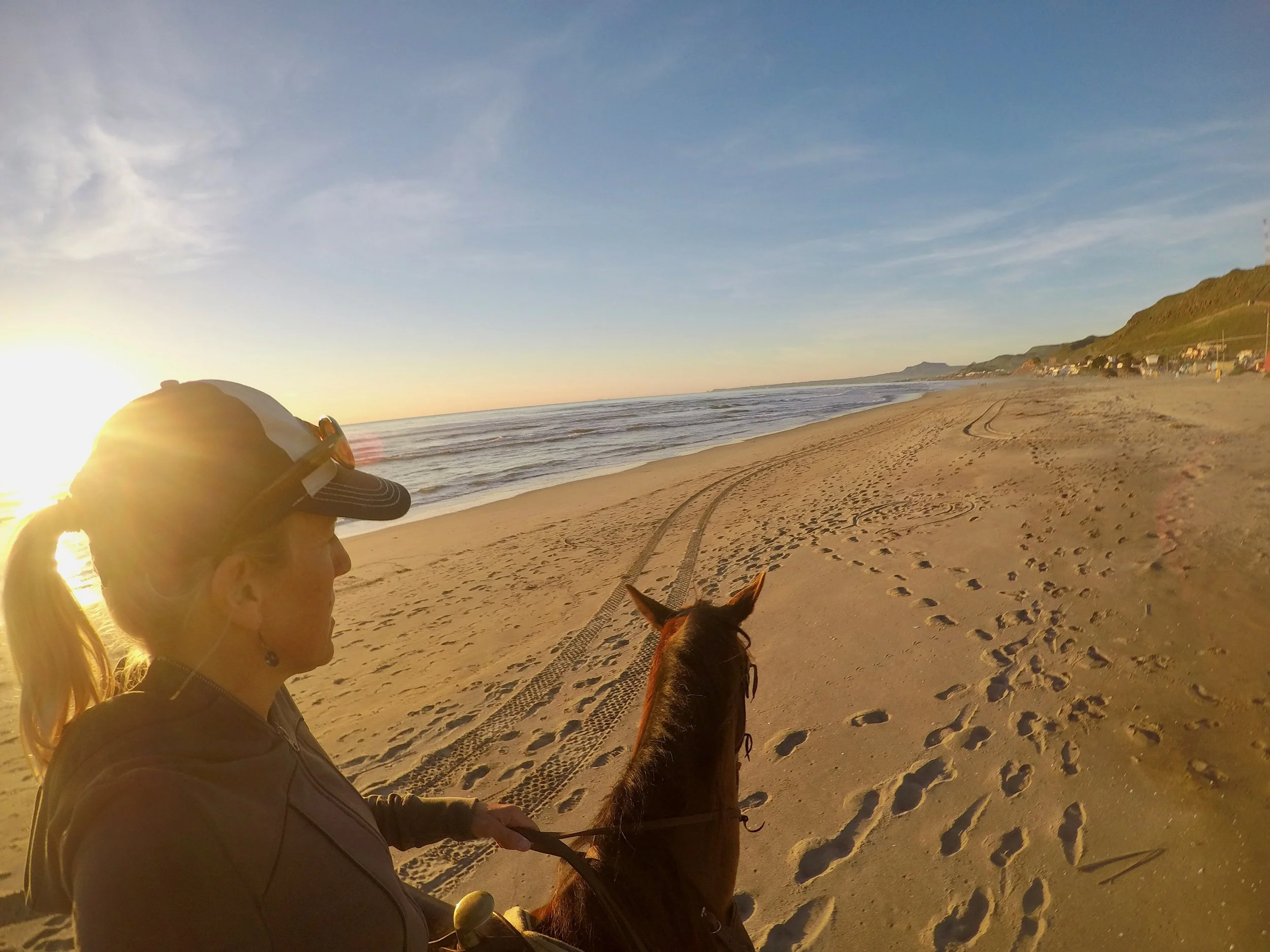
Luna and me, circa 2016, when we were beginning our journey together
I remember when I was first learning to ride and asked, “How do I get better, faster?” The response was quick and simple: time in the saddle.
It wasn’t what I wanted to hear.
I wanted a plan. I wanted a 12-step hack. I wanted a list I could check off so I could boom— go galloping down the beach without all the unnecessary mileage.
I’m a sucker for a conversion story. I love hearing how someone “once was blind” and “now sees.” I love the drama of Saul being knocked off his horse on the way to Damascus and becoming the Apostle Paul, or Dr. Richard Alpert falling at the feet of Neem Karoli Baba and rising as Ram Dass. There is something compelling about the instant transformation—the leaving of one way of being and the total entering into another.
But even for them, the “flash” was just the starting point. They still had to wake up the next morning and do the work. Like the Zen Koan says: “Before enlightenment; chop wood, carry water. After enlightenment; chop wood, carry water.”
There is another story from the Hebrew Scriptures about Naaman, a powerful Syrian army commander with a skin disease. He went to the prophet Elisha for healing, expecting a big production—maybe some chanting, some waving of hands, a theatrical miracle. Instead, he got a simple instruction: “Go wash yourself seven times in the Jordan River.”
Naaman balked. He was insulted by the simplicity. It was too humble, too small, too... boring. Luckily, his servants convinced him that if the prophet had asked him to do something difficult, he would have done it in a heartbeat—so why not try the easy thing? He did, and he was healed.
Why do we want things to be big? Why do we often balk at the simple?
I think complexity is often just a way to stay stuck. If I say I won’t run unless I can run a marathon, I never have to run the first mile. Complexity is an excellent excuse for never beginning. It protects us from having to try. And it protects us from the possibility of failing.
We say, “I don’t have time to meditate,” because we think meditation has to be an hour of Zen-like silence. But you don’t need an hour. You need ten minutes. If ten minutes is too much, try two. It doesn’t have to be perfect. You just have to begin.
It can be gentle.
It can be slow.
It can even be boring. That’s okay.
The way you become a better rider is to ride. You can read the books and watch the videos, but eventually, you have to put your feet in the stirrups. The way you become a meditator is that you begin to meditate. The way you become a runner is that you begin to run.
Our big, lofty goals often have a hidden agenda: to keep us from having to move at all. To keep us from the terrifying, humble work of changing and growing—one baby step at a time.
I am currently putting together a new self-guided toolkit called Like Water Through a Rock, the art of getting unstuck. I’d love for you to be a part of it. If you’re interested, let me know in the comments or hit reply, and I’ll keep you in the loop as it comes together.
