Para la Casa No Hay…
Do you ever have one of those days where you are feeling a bit low energy? Not depleted, exactly. Just tired. Without a lot of "forward." What do you do when you feel that sense of inertia?
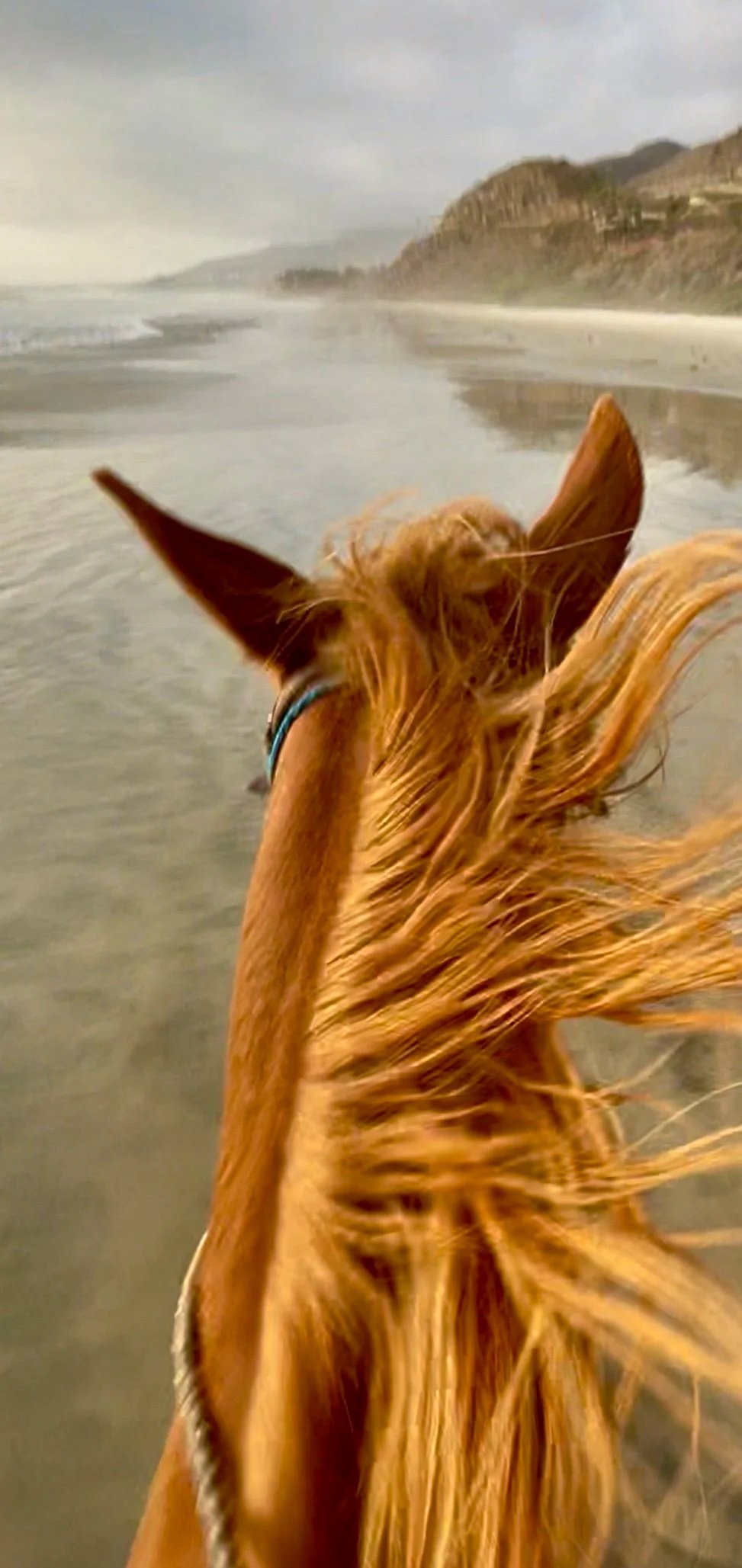
Yesterday, on our evening ride, Alegria had a lot of forward. By the time we got to the beach, she was ready to run. Ready to go. She wanted to feel the freedom. In fact, she wanted to keep going, even when it was time to turn around. It was exhilarating. I love that feeling of pure power and movement. It felt free—as though there could have been a movie soundtrack playing in the background as we rode into the sunset.
And yet… and yet, it is actually not that typical for horses. Normally, horses are eager to turn around toward home. There is even a phrase in Spanish: Para la casa no hay burro huevón. Basically—no one is lazy on the way home.
Why? Because home is where food is. Home is where rest is. Home is where friends are. Home is where every good thing is.
Only the day before, when I was riding Luna, I could feel her "home energy" expand the exact moment we turned around at the rocky point and headed back toward the ranch.
As I was sitting this morning drinking my tea and pondering life, I realized something: without consciously thinking about it, I assume that every single day should be a "forward" day—a galloping into the great unknown day—and when it is not, I immediately assume something is wrong.
Did I not get enough sleep? Am I not eating right? Was the workout too much? Am I overexerted? Underexerted? How can I fix this?
Those questions reveal a subtle assumption—the expectation of a "galloping down the beach" kind of forward every single day. A simple observation of horses shows us that is not actually the case. Author and horsewoman Tania Kindersley is fond of reminding us, “Not every day can be Doris Day.”
So who, or what, is it that is pushing, urging, and arguing that a day of low energy is somehow wrong?
It says: Do more. Be more. Produce more. Accomplish more.
As though the entire point of our existence were to do, to produce, to accomplish. It places an emphasis on the becoming rather than the being. As though who we are is not enough, simply in and of itself. As though being is a failure, and becoming is the only acceptable goal.
Without even realizing it, that sense of "not enough" and "do more" can overflow into everything. It tightens our vision into a hard-eyes stance—searching, seeking, uncovering—rather than a soft-eyes perspective that takes life in without trying to control, predict, or dictate.
That voice asks: What have you gotten done today? What time is it? You are already behind. You need to catch up. You need to make up for lost time.
But all of that catching up? Most of the time, it just keeps you chasing what is always just out of reach.
That "not enough-ness" gets marketed as drive, motivation, and the pursuit of excellence. But in reality, it’s just noise. It’s a pushing against.
The irony is, when we are in that state of scrunching, striving, and taking names, it actually blocks us from the very source we seek. It keeps us cut off from the exact thing that would actually feed us, nourish us, and give us back our true energy, motivation, and desire. It keeps us from home.
So why do we scrunch? Why do we relentlessly push forward?
We are told it is the responsible thing. The dedicated stance. Even the productive way of being. Hunkering down. Getting things done. Grit. Determination.
When in reality, the exact opposite is often what we need.
To release. To let go. To surrender. To accept. To sink, rather than scrunch. To come home.
