Soft Eyes
For some time, I have been pondering the idea of "soft eyes." I first came upon the concept in the world of horsemanship, via Sally Swift’s Centered Riding. When I first encountered the idea nearly a decade ago, I thought it was simply a technique for riding. But, as with most lessons found around horses, it turns out it is actually about life as well.
What are soft eyes? I have come to think of them as a way of being rather than a task to perform. Biologically, we humans carry the physical markers of a predator: our eyes are set in the front of our faces, allowing for depth perception and a narrow, laser-like focus. This "hard eye" is the gaze of the stalker; it is the vision of the hunt. It is incredibly effective for crossing items off a to-do list or solving a complex puzzle, but at times it can come on far too strong in the presence of others. To a horse—an animal whose eyes are set on the side of its head to scan the horizon for danger—our direct, linear, intense stare can feel like a threat before we’ve even said a word.
Soft eyes are the conscious antidote. They say, "I am not a threat." They signal a refusal to consume or control the space.
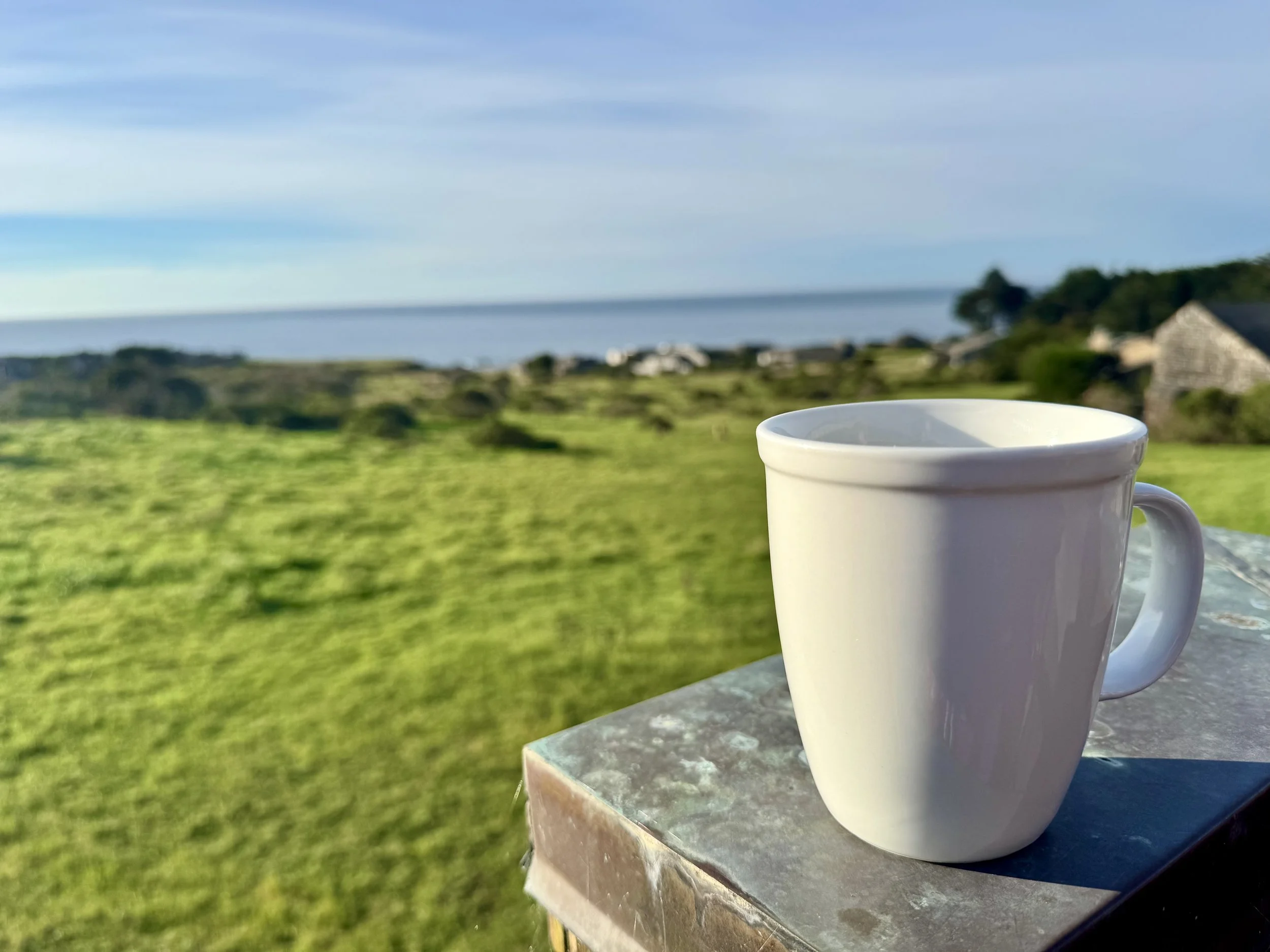
Just this morning, I had the chance to practice this with a herd of deer grazing on the green grass outside the coastal cabin a few friends and I are visiting. I walked out onto the porch to enjoy the morning sun and get a better view of the deer happily grazing. For a while, we shared a bit of quiet, mutual peace. But the moment I reached into my pocket for my phone to capture the moment, the energy shifted. Their ears snapped up - their bodies tensed. It wasn't just the movement that had startled them, it was the shift in my internal energy. I was no longer merely being with them; I was suddenly trying to capture them. I had a goal, a "prey" in the form of a photo.
Recognizing their concern, I intentionally dropped my gaze and relaxed my energy. I widened my peripheral vision, letting the trees and ocean and the sky back into my awareness. I moved away from the intensity of the photographer wanting to capture the moment and back into the softness of the guest enjoying the sunshine. They watched me for a heartbeat, sensed the relaxation of my intent, and returned to their grazing.
Without realizing it, I think we so often approach our lives with "hard eyes." We enter rooms with an agenda, a plan, or a solution already gripped in our hands. It isn't that hard eyes are inherently "bad"—some situations require that decisive, narrow focus to survive or succeed. But our habit of intensity often works against us, scaring away the very things we wish to draw near - intimacy, trust, and creativity.
There is a patience that lives within soft eyes. It is a patience that is not just the absence of hurry, but also the presence of, well, presence. It is a willingness to let things arrive in their own time. It is a relaxing of the need to consume or control or conquer. I see this in the conversations I have with a close friend. We share our current "obsessions"—hers being quilting, mine being investing and nutrition. We aren't trying to "teach" or "fix" one another; we are simply sharing what we are absorbing. Because there is no pressure to retain every fact or "do" something with the information, the learning sinks in like water making its way through rock. It is learning by osmosis, a quiet gathering of wisdom that happens when the ‘predator’ side of us is at rest.
I suspect this is what draws us so deeply to horses. They are massive, powerful beings, yet they inhabit the world with a peripheral consciousness, with a sense of presence. They remind us that there is another side to our nature—the side that isn't seeking to conquer, but to sense for safety and community.
Perhaps this is also why it feels so jarring, particularly for women, to see horses treated with a domineering hand. We recognize that "hard eye" approach because we have felt it directed at us—the gaze that sees a tool to be used rather than a life to be collaborated with. To choose soft eyes is to honor the agency of the other. It is an invitation to work together from a place of mutual presence, rather than overpower with dominance.
I wonder, can you sense the difference within yourself? Can you sense the difference from when you are in more of a ‘hard eyes’ focus and when you can shift into soft eyes? When you release the need to ‘capture’ the present moment and allow yourself simply to receive it. To let life come to you, rather than always stalking it. And, who knows? You might find that when you stop ‘stalking’ the life you want it finally feels safe enough to come to you.
