On Effort and Avoidance (Finding Your Seat)
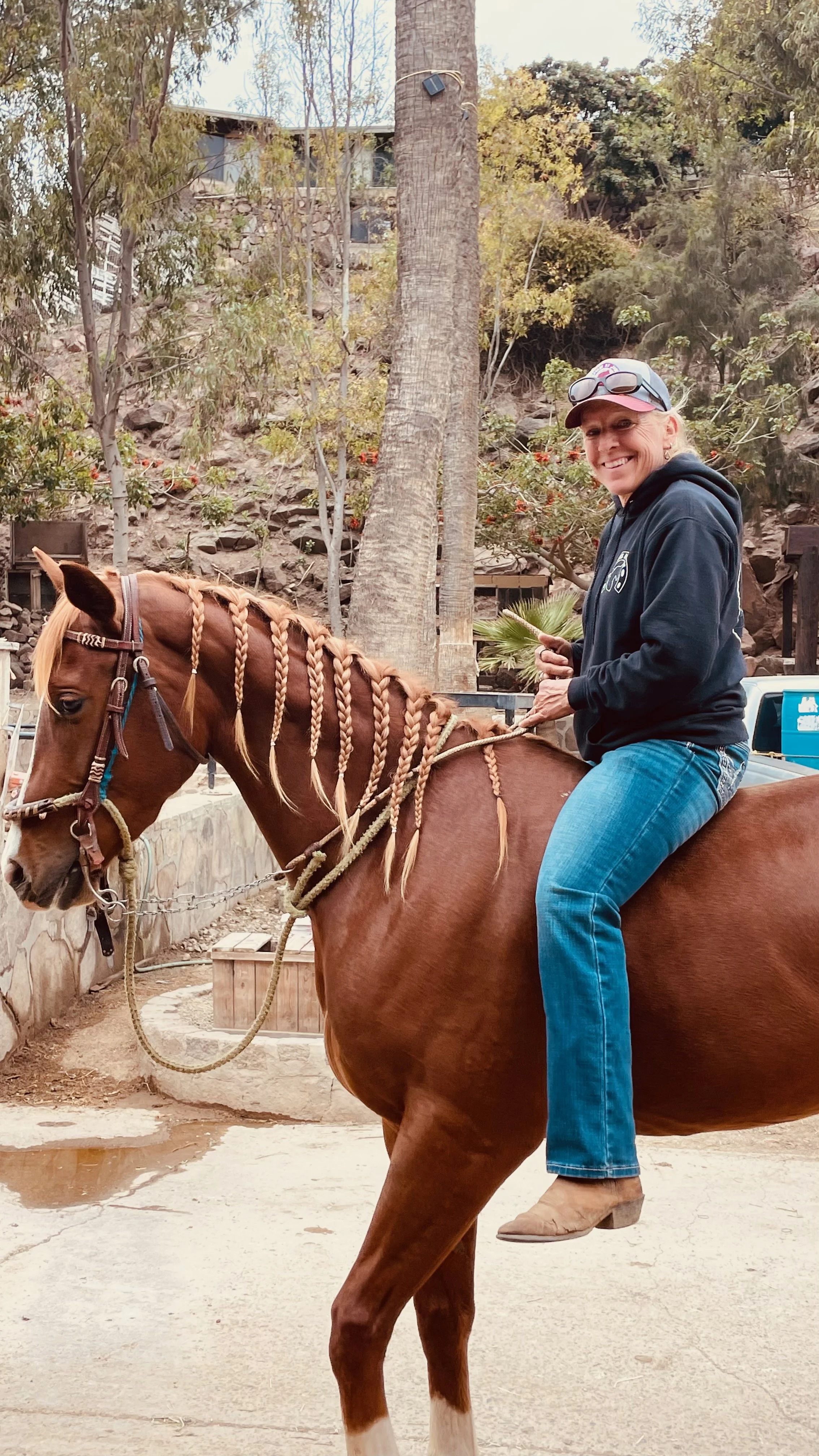
I had somewhat of a startling, though not surprising, revelation the other day. I realized that I have spent much of my life avoiding the situations that would actually help me gain a "deep seat."
A deep seat is a term used in horseback riding to mean a balanced, centered, grounded connection between horse and rider. This deep seat means the rider is not as easily thrown off balance, but also that the rider has a clearer communication with the horse. A deep seat is something to be sought and also practiced.
A deep seat, I think, also applies to life.
I realized, that in life, if something felt "too hard," I skipped it. This is the shadow side of being a good student, an overachiever, and someone for whom a certain level of success comes easily. You don’t build the muscles required to truly improve; you simply rely on the ones you already have—the ones that come naturally—and forget about the rest. This strategy works fine as long as you can navigate life without ever needing those dormant muscles. But the odds are you will eventually need them, and when you do, they will be atrophied from lack of use, and you won’t be able to summon the strength to meet the moment.
This is exactly what happened to my physical body. For years, I worked in my garden—and by "working," I mean the visceral, heavy labor of pickaxing giant boulders to clear the ground for fruit trees and vegetables. Then, one season, I stopped. It wasn’t a conscious choice; life simply became crowded with other things. One season became two, then three.
After a few years, I went to pick up where I had left off and discovered something startling and troubling: I couldn’t. The intervening years of dormancy had done their work. My muscles had literally begun to atrophy. I no longer had the strength to move the earth. I had always heard the phrase "use it or lose it," but I hadn't realized it was an actual law of nature until I experienced the loss for myself.
But instead of seeing that lack of strength as a challenge—a signal to dive back in and rebuild—I assumed it as a defeat. I told myself, I guess that is no longer something I can do. I decided I was "done" with shoveling trenches for rainwater harvesting and doing the heavy lifting. I ran into an impediment, and instead of engaging with it, I surrendered.
It wasn't the "good" kind of surrender—the kind that comes with a knowing and peaceful acceptance. It was the "bad" kind: resignation. I told myself, "I guess it’s not for me," when what I really meant was, "This doesn't come easily anymore, so I’m turning away."
I am not suggesting that "no pain, no gain" is the ultimate answer. When that mantra is used to push relentlessly without an understanding of limits, it is hardly noble. But there is a version of it that is worth holding onto—the aspect that encourages you to lean into a hard situation rather than shrinking from it.
As I looked closer, I saw the pattern. My unintentional motto had become: If at first you don’t succeed, look for something else. There is a certain strain of self-help and spiritual literature that reinforces this. It suggests that if something is hard, it’s a sign that you are on the "wrong path." It argues that the right life should have a certain effortlessness about it.
To that, I say: yes and no.
There is certainly no virtue in struggling for struggle’s sake. There is no reason to stay "stuck" just to prove you can endure. We see that shadow side in the spiritual world, too—the nobility of suffering as a badge of honor to prove one isn't a "lightweight." But many things in life require a heavy lift. They require sticking with the work even when it feels like pushing a boulder uphill. It is in that specific struggle that strength is found.
It’s not that we should intentionally seek out struggle, but we also shouldn't run from it the moment it arrives. If we avoid it at all costs, we never develop the gravitas we need to move forward.
Take horseback riding, for example. If we spend all our energy ensuring there are no unexpected moments—no plastic bags blowing in the wind to cause a spook—we miss something vital for both the horse and ourselves. We miss the opportunity to prove that the world can be unpredictable and we can still navigate it. We miss the chance to show ourselves that we can encounter the unexpected and not only endure it, but thrive through it.
If we take every challenge as a sign that we’ve chosen the wrong path, we will spend our lives perpetually returning to the starting line. We will keep switching tracks, thinking we just haven't found the "easy" one yet, rather than seeing every path as an opportunity to grow.
We don’t suffer for suffering’s sake, but by encountering the struggle along the journey and refusing to turn back, we discover who we actually are: strong, capable, and able.
