The Art of Seeing: On Puzzling and Presence
It is said that the legendary investor Warren Buffett kept a "too hard" box on his desk. Any investment he was considering that he couldn’t fully understand would go straight into that box. I wonder if we don’t all have a version of the "too hard" box in our lives, whether literally or metaphorically? And though I’m not going to argue with the Oracle of Omaha on investing strategies, I have begun to wonder if this is the most helpful life strategy.
About a year ago, out of nowhere, I took up puzzling. Perhaps it is simply a sign that middle age has arrived in full force, despite my best efforts to pretend otherwise. But I like to think it is something more. Puzzling is a strange contradiction: it is both addictive and therapeutic. There is a visceral sense of accomplishment when a piece clicks into place, and something in the methodical sorting of edges and colors appeals to a deep-seated desire to bring order out of chaos.
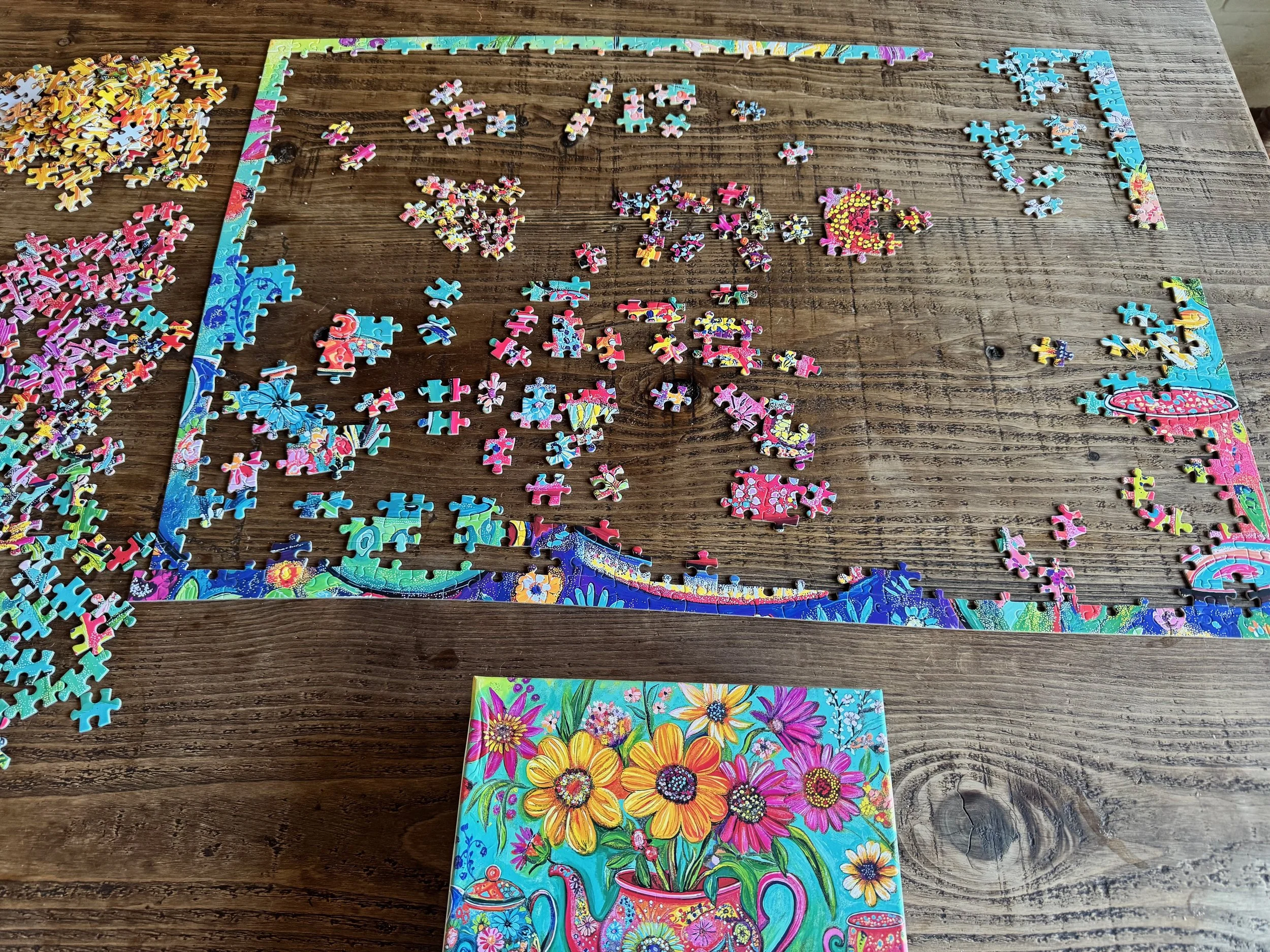
I had successfully completed a few puzzles when I finally met my match. It looked beautiful—a vibrant, multi-colored scene—but a few hours in, I realized I was in over my head. The "Colorful Teapot Garden" was simply too much. Defeated, I swept the pieces back into the box and stored it on a high shelf. The "too hard" pile.
Fast forward a few months. Anthony, who had stayed in my casita, returned for a second visit with his girlfriend. Noticing I had been working on a puzzle during his first stay, they brought a thoughtful—if daunting—gift: "The World of Grimm’s Fairy Tales," a 1,000-piece jigsaw puzzle.
Just looking at the box top made me cringe. The tiny, intricate details were overwhelming. But because it was a gift, I wanted to at least give it a try. I began in December. Yesterday, Tuesday, March 10, I finally finished. To be clear, puzzling is a "when I have a chance" activity for me, so finishing faster wasn’t the goal (unlike those professional puzzle competitions—yes, they really do exist).
You might wonder why I’m telling you so much about jigsaw puzzles. Have I lost my connection with reality? No. It’s because something unexpected happened during those months with the Grimm’s Fairy Tales.
I began to see.
What at first appeared to be an impenetrable thicket of detail slowly began to reveal itself. It wasn't just a mass of "the same thing." There were patterns, subtle designs, and nuances that became not only distinguishable but obvious the more time I spent with them. Along the way, I had my niece over for dinner and, as she looked at the progress, I remarked, "It’s pretty easy, isn’t it?" She looked at me like I was crazy.
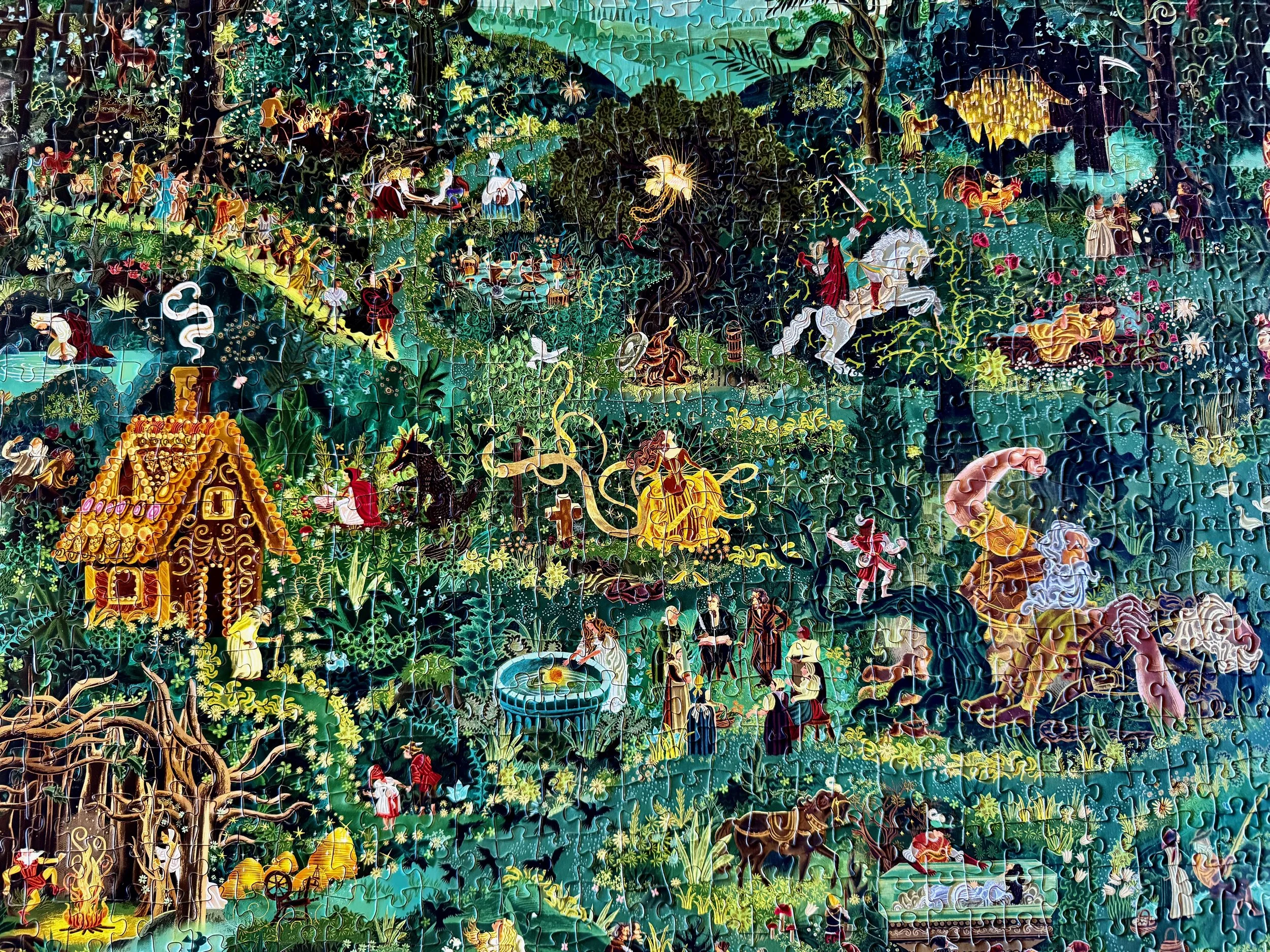
The truth was that spending time with the puzzle without the pressure to "achieve" or "finish" allowed a new kind of seeing to emerge. It reached a point where I could look at a single piece and know exactly where it belonged. I wasn't just finding shapes; I was tuning into a different frequency.
With this newfound confidence, I went back to the "too hard" shelf. I wanted to see if anything had changed with the Colorful Teapot Garden.
I poured the pieces onto the dining room table (I really need a dedicated puzzling table, but for now, this will have to do). Immediately, I was reminded why I had given up. It all looked the same. Hundreds of yellow pieces; hundreds of pink pieces. The colors bled together in a confusing blur. I was tempted to sweep them back into the box immediately.
But the Grimm’s puzzle had changed me. I sat down and began to sort. And then, the miracle: I realized that not all the yellows did look alike. There were subtle shifts in shade and tone. The pinks had different textures and tiny patterns hidden within them. As I slowed down, the pieces began to reveal their uniqueness.
What my mind had previously categorized under the generic label of "pink" suddenly revealed its individual shape and spirit. It was an invitation to look more deeply—to notice, to pay attention, to appreciate a nuance I hadn't realized was there.
My current life is far removed from the mainstream. I don’t commute, I don’t work in a high-power corporate office, and I am not "busy" in the traditional sense. And yet, I’ve realized how easy it is to still move from one thing to the next without being present—to carry that busyness inside of me even though my externals don’t warrant it. Whether you are in a cubicle or a corral, you can still carry a "hurry" in your soul.
It is that very hurry that spending time with horses invites you to surrender. Horses are unable to be anywhere but the present moment. They aren’t busy ruminating over the past or worrying about the future. They are here. Now. Spending time with them is an invitation into that "here now-ness."
Just like the Grimm’s Fairy Tales or the Teapot Garden, unless you take the time to truly look—to actually see—your hurry will keep you blind. It will keep you from noticing the pattern, making the connection, and appreciating the nuance of the world right in front of you. The invitation is to be—and in being, to see; and in seeing, to connect. For isn’t connection what we are after anyway? To connect with ourselves, to connect with others, and to connect with Source.
It turns out the "too hard" pile wasn’t too hard—I just didn’t have eyes to see. Sure, if hurry was the goal, then finding something easier was the solution. But if seeing was the goal? Then the Grimm’s Fairy Tales, the Teapot Garden, and the horses were the perfect teachers.
