The Safety of Sanctuary: A Story of Gato and Pato
I’ve been thinking lately about safety, about being safe. And I wonder if we don’t have a habit of confusing survival with living? It’s as though we think that if the body is intact, the being is secure. The problem is, we often build our own prisons and call them "security," not realizing that a life without risk is often a life without breath.
My mom has a cat named Gato. He is an indoor cat. Growing up in the 70s, our cats were always "indoor-outdoor" creatures. But that was a different era—a time of cars without seatbelts and kids waiting alone in the car at grocery store parking lots while their mothers shopped. Nowadays, in the suburbs of Southern California, letting a cat roam free is treated like an act of extreme negligence. The reality is, the coyotes are no longer shadows of the night—they prowl in broad daylight, hunting the small creatures in their paths.
So, Gato lives his life inside. He is kept "safe." He has everything he needs—food, water, a litter box, even a "cat tree" for climbing. All his physical needs are met. But the thing is, life cooped up 24/7 is a safety, yes, but it is a safety that comes at a cost. It is a safety that suffocates. It is a preservation of the body - but is it at the expense of the spirit?
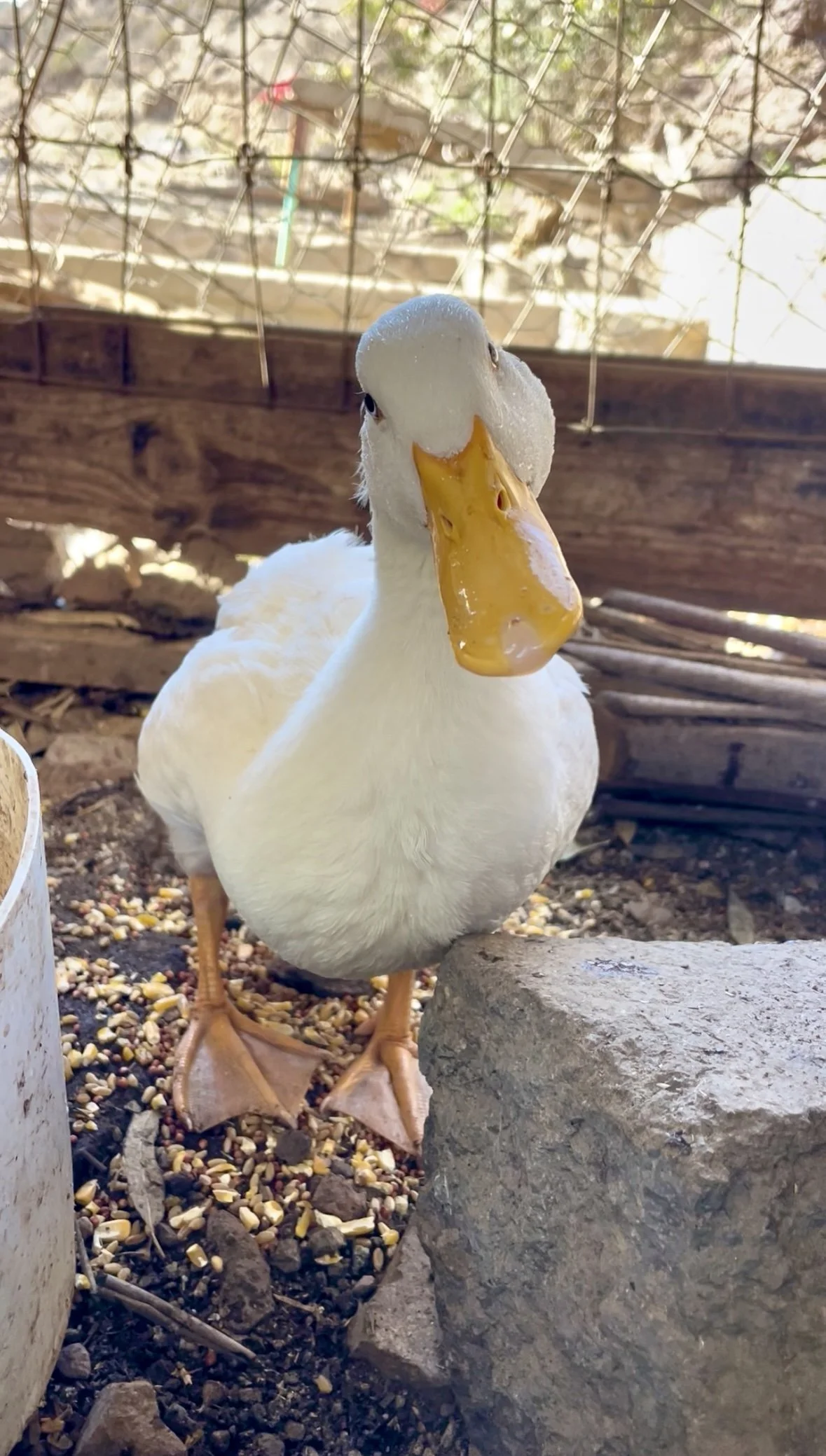
It makes me think of Pato, the duck. He came to the ranch unexpectedly. He was a creature of immense personality who shared a strange, inseparable bond with the turkey, Pavo. Initially, Pato lived in a cage—a temporary measure to keep him out of trouble and trouble away from him. But eventually, the cage began to feel like a prison for a creature meant for waddling, water, and sun. So, we opened the door. We filled a watering hole. Pato was free. He waddled and swam and had a lot to say about both.
The tragedy of Pato was the tragedy of the natural world. In the late afternoon, the chickens, the turkey, and the roosters would fly up into the tree branches to roost. But Pato couldn't fly. He remained a "sitting duck" on the ground. One early morning, the dogs got him. All that remained were white feathers scattered across the dirt. I was crushed.
Could we have done more? Perhaps. We could have forced him back into the cage every night, though he hated the constriction. We could have kept him cooped up forever. He would have been "safe," but he wouldn't have been free. He wouldn’t have been Pato.
This brings me back to Gato, the cat. If he ventures outside, the reality is that a coyote might eat him. But if he stays in, he is eaten alive by the frustration of his own instincts. Which path is truly more dangerous? Which path is more safe?
We ask the same questions of our own lives, don’t we? After recent violence in Mexico, many reached out to ask if I was "safe." I appreciate the concern; it feels good to be cared for. But I find myself wondering what "safety" actually means in a world of school shootings and communal rage, of pedophiles and predators. We are told we must be "safe" from the stranger, the "other," the immigrant, the foreigner, the different political party. We build walls and divisions—righteously, even, in the name of security. Yet it is precisely this "othering" that acts like a poison from within. We are like the frogs in the kettle, not realizing the rising heat of our own isolation is what is actually killing us.
The deepest irony is that the people who demand our trust—the ones who claim they will keep us safe—are so often the ones preying on the vulnerable.
I was once one of those vulnerable ones. I went to church, the place that is supposed to be the ultimate sanctuary. But the man in charge of leading our youth group was not a protector; he was a predator. The very institution meant to be a fortress against the world's darkness became the place where the darkness was allowed to thrive.
What is "safe," then? Is it just a story that those of privilege tell ourselves so we can sleep at night? Perhaps "safety" as we’ve defined it—the total absence of risk—is indeed an illusion. A cage is safe, but it is not a life.
Yet, there must be a middle ground between the cage and the coyote.
Maybe real safety isn't found in walls or locks, but in creating sanctuary. In becoming sanctuary for one another. A cage is something you are put into; a sanctuary is somewhere you choose to go. Real safety is found in the hands of people who see our wildness and don’t try to domesticate it, but instead stand watch while we rest. Like a lead mare in the herd who stands watch while the others graze, or sleep. It’s found in communities that don’t "other" the stranger, but instead build a bigger table.
It reminds me of a line from the Chronicles of Narnia. Susan, one of the children who has come into Narnia, asks Mr. Beaver about Aslan.
"Aslan is a lion—the Lion, the great Lion." "Ooh," said Susan. "I'd thought he was a man. Is he—quite safe? I shall feel rather nervous about meeting a lion." "Safe?" said Mr. Beaver. "Who said anything about safe? 'Course he isn't safe. But he's good."
What if safe is not a place devoid of risk? What if safe is not a place where nothing bad can happen? What if safe is a place where you are not alone when it does?
