The Trash We (Don’t) See
About a decade ago, a neighbor was rallying our community to help with a massive trash clean-up at the beach. In those days, there were no trash cans on the sand, and over the busy week of Semana Santa, the thousands of visitors left behind a wake that was, quite frankly, ugly.
(I should note that in the decade since, the situation has improved exponentially. The government now empties bins, local vendors do weekly sweeps, and the shoreline is nothing like it once was.)
In fact, the situation has changed so dramatically that I might have forgotten it entirely, if not for a comment another neighbor made at the time: “This is the trash you see—but what about the trash you don’t see?”
His point was that it is easy to condemn the person who leaves a plastic bottle on a beautiful stretch of beach. It is definable and measurable. But what about those who discard a "trash" that is invisible to the eyes, yet far more toxic in reality? What about the pollution in the water, the air, and the soil? That "trash" is harder to recognize, and infinitely harder to clean up.
I’ve been thinking about that neighbor’s comment lately, though not in relation to litter. I’m thinking about it in relation to "danger."
Recently, reports of cartel violence in mainland Mexico have dominated international news. Let’s call this the "trash you see." Like literal trash on a beach, it is ugly, it is real, and it is certainly not part of the ideal ambiance. It is not to be ignored. However, it is also incredibly easy to become paralyzed by the sensationalism of the reporting.
Just this past week, we had groups cancel their horseback riding excursions here in Baja because of the "situation" happening in mainland Mexico. They are being told they should be afraid. They are being told by their governments that it is unsafe to travel here.
Logistically, it is the equivalent of canceling a trip to San Diego because of a shooting in Chicago. But the disconnect goes deeper than a simple lack of geography.
It is about the trash we don’t see.
As Americans, we have a particularly salient blindness when it comes to what constitutes "safety" and what constitutes "violence." We are terrified of the definable, external threat, while we shrug at the silent, internal ones.
What about the danger of the high-stress lives we live? What about the danger of the "hustle," the chronic lack of sleep, and the perpetual burnout? What about the danger of vegetables that have traveled thousands of miles and months of time to arrive at a supermarket devoid of flavor or nutrition?
It is easy to shrug away these dangers. They don’t look like the violence we see on the evening news. But the statistics tell a different story.
In the U.S. alone, approximately one million people die each year due to diet-related chronic diseases—heart disease, stroke, and type 2 diabetes. Experts from the CDC and Harvard suggest that up to 80% or 90% of these deaths are entirely preventable through lifestyle modifications.
Let that sink in. One million people. In a single year, that is more than triple the number of people killed by homicide ("violence") in both the U.S. and Mexico combined over the past decade.
The trash we don’t see is the cortisol coursing through our veins as we navigate traffic, deadlines, and digital noise.
So, back to the horseback ride.
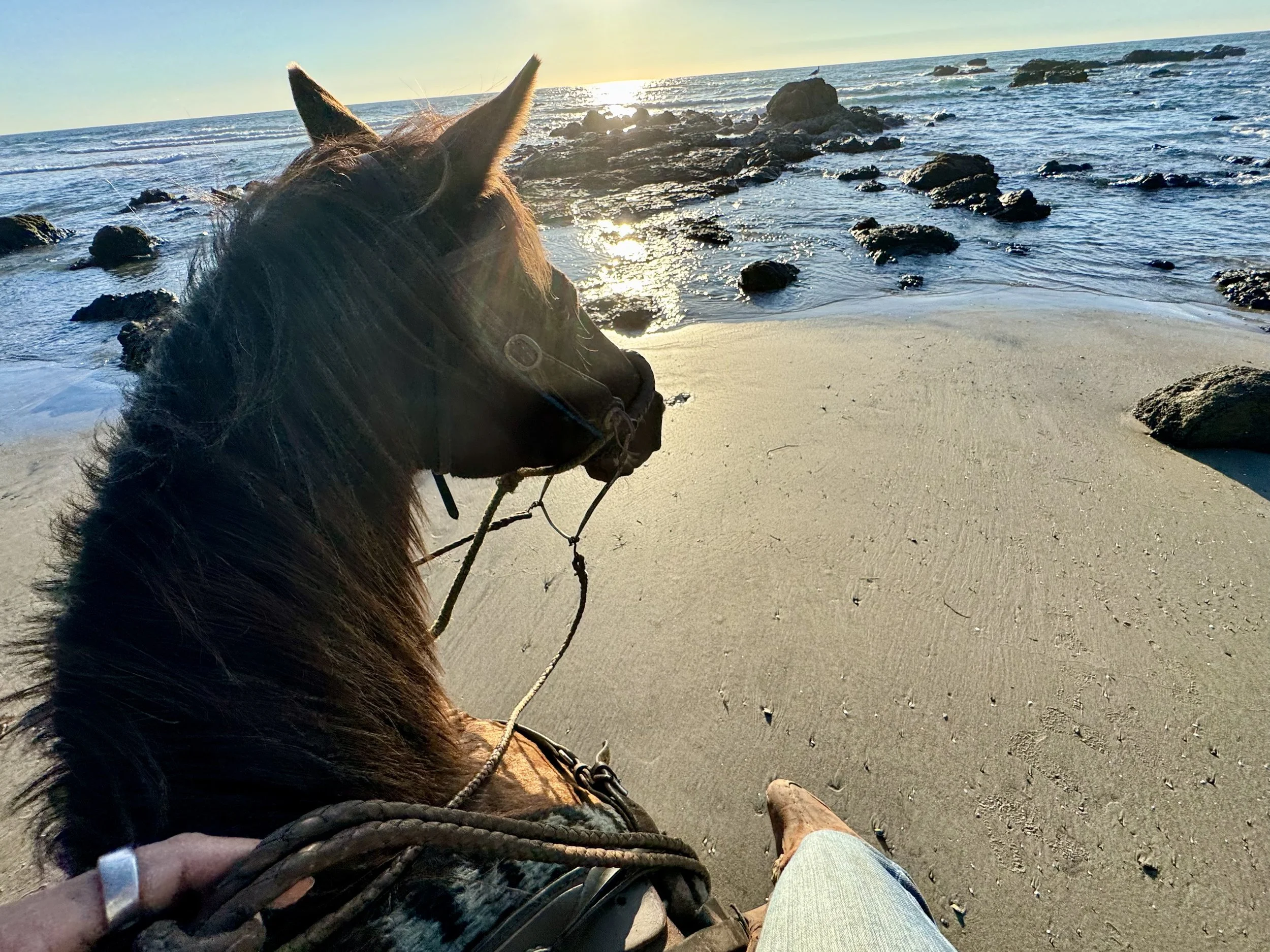
When someone cancels a ride through the quiet estuary and along the spectacular beauty of the Pacific because they have been told it is "unsafe," they are performing a tragic trade. They are canceling their opportunity to get away from the very "trash" that is actually killing them—the stress, the hectic, the hurry.
It is the equivalent of burning a pile of physical trash to stay "safe" from it, while breathing in the toxic fumes as it burns.
That horseback ride is not just a luxury—it is a physiological intervention. Science tells us that being in nature lowers blood pressure and cortisol levels almost instantly. Being around horses—animals that require us to find our "soft eyes" and a calm nervous system—tells our brain that we are, in fact, safe. The birdsong along the trail, the rhythm of the horse’s gait, and the vastness of the coastline provide the body with natural endorphins that shift our energy from "survival" to "life."
We are so afraid of the rare, visible threat that we have become comfortable with the constant, invisible one. We stay home to be "safe," staying plugged into the very world that is making us sick.
Perhaps real safety isn't found in staying away. Perhaps real safety is found in the places that allow us to finally exhale. Don't let the trash you see keep you from cleaning up the trash you don't.
